Brakes
Mobile Brake Service Cost vs Shop in Dallas
· 12 min read · Mobile Mech LLC
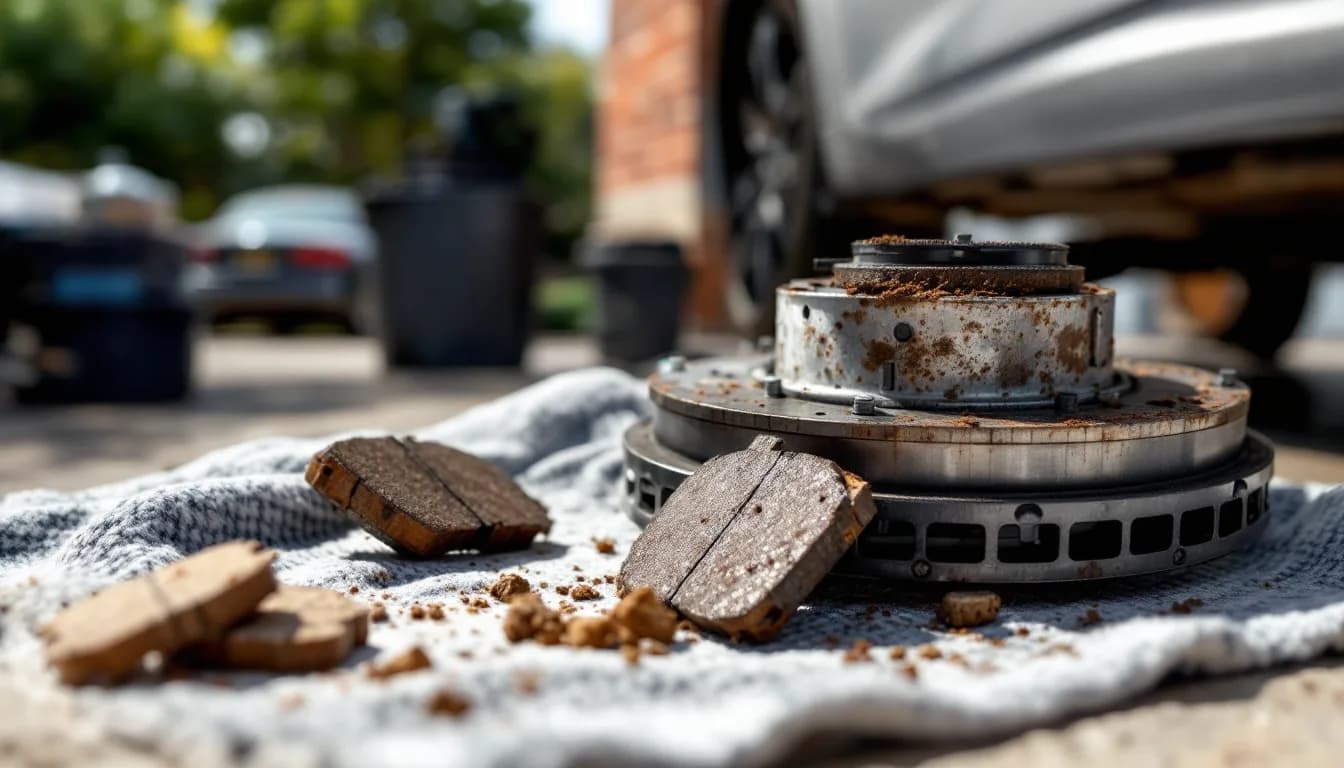
What does a brake job cost at a mobile visit versus a shop in Dallas?
A brake job in Dallas costs about the same in parts and labor whether it is done in a driveway or in a bay, and the difference between a mobile visit and a shop is in what surrounds those two lines: the day off, the ride, the second trip, and the four-wheel quote that follows a sound rather than a measurement. At a mobile visit in Dallas-Fort Worth, pads on one axle run $180–$320, pads and rotors on one axle $320–$620 and pads and rotors on both axles $620–$1,200, with the trip included inside 30 miles of east Dallas, every wheel measured before the quote and the pads bedded on a road test from your address. This guide puts those figures beside what a shop charges for the same line items, explains what moves each one, and lists what a driveway brake job has to include to be as good as a bay's. If the brakes are grinding today, email service@mobilemechllc.com with the vehicle and the sound and the reply comes with a range.
How does a brake system wear, and what are you actually paying to replace?
A disc brake, as Wikipedia puts it, "uses the calipers to squeeze pairs of pads against a disc or a rotor to create friction," and the pads are designed to wear away while the rotor wears slowly. A pad starts life with around ten to twelve millimeters of friction material; most manufacturers call for replacement at three, and a wear indicator, a small metal tab or an electronic sensor, warns a millimeter or so before that. A rotor has a minimum thickness cast into its hat, and once it wears below that figure it cannot shed heat safely and must be replaced.
The caliper is the part that squeezes. It slides on two pins that must stay lubricated and sealed; when a pin seizes, one pad does all the work and wears at twice the rate while the rotor on that side overheats. Brake fluid is the fourth part of the system and the one most often ignored. It absorbs moisture through the hoses and the reservoir cap, and after two or three Texas summers it can hold enough water to lower its boiling point by a third, which is the soft pedal that appears after a string of hard stops on a hot afternoon.
What you pay to replace, then, depends on which of those four has reached its limit, and the only way to know is to measure. Pad thickness at every wheel, rotor thickness against the stamped minimum, slide pin movement, fluid moisture content. Those four numbers decide the job, and they belong on the estimate.
What are the real line items, and how do mobile and shop prices compare?
The table lists the typical mobile ranges from the pricing page beside what the same work commonly runs at an independent shop and a dealer in Dallas-Fort Worth. The shop and dealer figures are typical of the metro rather than quotes, and the point of the table is the shape of the comparison rather than any single number.
| Line item | Mobile visit, typical range | Independent shop, typical range | Dealer, typical range | What moves the figure |
|---|---|---|---|---|
| Pads, one axle, with hardware | $180–$320 | $180–$350 | $250–$450 | Pad compound, wear sensor, parking-brake reset |
| Pads and rotors, one axle | $320–$620 | $350–$700 | $500–$950 | Rotor size, vehicle weight, coated versus plain rotors |
| Pads and rotors, front and rear | $620–$1,200 | $700–$1,400 | $1,000–$1,900 | Everything above, twice |
| Caliper, per corner, with bleed | $220–$450 | $250–$500 | $350–$650 | Caliper type, electronic parking-brake motor |
| Brake fluid exchange | $110–$180 | $100–$200 | $150–$250 | ABS routine required, DOT grade |
| Diagnostic fee for a brake complaint | Included in the measurements | $90–$180 | $150–$250 | Whether the shop charges to look |
| Your time and transport | None | Drop-off, ride, collection | Drop-off, ride, collection | Two trips across the metro |
Three things stand out. The parts and labor lines overlap heavily, because the pads, rotors and calipers come from the same suppliers and a competent technician takes about the same time in a driveway as in a bay. The diagnostic line disappears at a mobile visit because measuring the brakes is part of quoting them. And the last line, which no invoice shows, is the one that decides most comparisons: two trips across Dallas, a ride each way, and the hours between.
A fourth point is harder to put in a table. A shop that quotes four wheels from a squeal has an incentive the measurements remove. A technician who measures every wheel in front of you and writes the numbers on the estimate quotes the axle that is at its limit and tells you when the other will be due. That is not a mobile versus shop distinction in principle, but it is the practice a driveway makes easy to verify.
What moves a brake job inside its range?
The vehicle, first. Rotor diameter and pad size scale with weight: a compact sedan carries small rotors and sits at the floor of each range, a three-row SUV or a half-ton truck carries large ones and sits in the middle, and a European performance sedan or a heavy-duty truck with large coated rotors sits at the ceiling. The parts for a Tahoe cost more than the parts for a Civic, and the labor to lift and handle them takes longer.
The pad compound, second. Ceramic pads are the default for sedans and crossovers: quiet, low-dust, and comfortable with the stop-and-go on Central Expressway. Semi-metallic pads cost a little more and belong on trucks that tow, SUVs that run heavy and vehicles driven hard, because they handle heat better and fade later. Performance European vehicles get pads from the suppliers that make the factory parts, because their stability systems are calibrated for that friction behavior, and those pads cost more again.
The electronic parking brake, third. Most vehicles built in the last decade carry a motor on each rear caliper instead of a cable, and changing rear pads means commanding those motors to retract with a diagnostic tool, then calibrating them afterward. That tool session is inside the rear-axle range, and it is the step a cheap mobile brake job skips, which is why those jobs end with a parking-brake fault on the dash.
The calipers, fourth. A caliper that slides freely is cleaned, lubricated and reused; one with a seized pin or a sticking piston is replaced, and that decision is made by moving it, not by assuming. A seized caliper is also the usual reason one axle wore out far ahead of the other, and replacing the pads without it means doing the job again in six months.
What does a driveway brake job have to include to match a shop?
Everything a bay does, with no shortcuts the bay would catch. The vehicle on a level surface, one axle lifted on a floor jack and held on rated stands with the opposite wheels chocked. Every wheel measured before the quote: pad thickness through the spokes or with the wheel off, rotor thickness against the stamped minimum, rotor face checked for scoring and heat spots, slide pins tested for movement, fluid tested with a meter.
Then the work. Caliper and bracket off, old pads and hardware out, rotor off, and the hub face cleaned to bare metal with a wire wheel, because a new rotor set on a layer of rust has runout from the first mile and shudders within a month. New rotor on, new hardware clips in, slide pins cleaned and lubricated with the correct grease, new pads with their shims, caliper torqued to specification. On an electronic parking brake, the motors retracted with the tool before the piston is compressed and calibrated after. On a vehicle with a wear sensor, the sensor replaced and the counter reset so the dash message clears.
Then the finish. Brake fluid exchanged when the meter says so, with the correct DOT grade and a bleed at every wheel, through the tool on vehicles whose ABS units must cycle to purge old fluid. Wheels torqued with a calibrated wrench, not an impact gun, and the torque figure written on the invoice. A road test from your address to bed the pads: a series of moderate stops from speed that mates the friction surfaces, so the brakes are ready to use normally the moment the technician leaves. The brakes at home page describes each of these steps and the measurements that decide the job.
What a driveway cannot do is resurface a rotor, because rotor lathes do not travel. On most modern vehicles that is no loss: factory rotors are thin enough that a resurfaced one is close to its minimum, and a new rotor from the suppliers the manufacturers use costs little more than the machining would. A rotor above minimum with no damage is kept; one below it is replaced.
Why does Dallas heat make the brake job harder, and how does the pad choice answer it?
Summer in North Texas is the hardest test of a brake job. A rotor that was not seated on a clean hub, a pad that was not bedded, a slide pin that was not lubricated, a fluid that was not exchanged: each shows up in the first week of hundred-degree afternoons, as shudder, as squeal, as a pedal that goes long on the way down the I-30 grade with a boat behind. The habits in the section above exist to get through that week quietly.
The pad choice is the other answer. A ceramic pad on a commuter sedan runs cool and quiet through a Dallas summer and leaves the wheels clean. A truck that tows to Lake Ray Hubbard or carries a bed full of tools on I-635 needs a semi-metallic pad that keeps its bite when the rotor is hot, even at the cost of a little more dust and noise. Fitting the ceramic pad to that truck because it was cheaper is how a brake job that looked fine in April fades in July.
The economics of the choice are small against the cost of driving. AAA's Your Driving Costs 2024 puts the average annual cost of owning and operating a new vehicle at $12,297, per AAA; the difference between the right pad and the wrong one on a truck is a few tens of dollars inside that figure, and the difference in stopping distance on a hot grade with a trailer is not measured in dollars. The National Highway Traffic Safety Administration's road safety material treats brakes and tires as the two systems that most directly decide whether a crash happens, and the tire half of that is worth checking at the same visit: NHTSA's tire guidance covers pressure and tread, both of which the technician records while the wheels are off.
How often do brakes need attention on a Dallas commute?
There is no mileage interval for brake pads, only a measurement, and the measurement moves with the route. A commuter sedan that runs Richardson to Downtown on US-75 in stop-and-go traffic wears front pads in 30,000 to 40,000 miles; the same sedan on an open highway run doubles that. A three-row SUV loaded with children and gear on the Tollway, or a half-ton truck towing to Lake Ray Hubbard, sits at the short end of its range. Rear pads on most vehicles last longer than fronts, but on vehicles with electronic parking brakes and stability systems that use the rear brakes to trim the vehicle, the gap has narrowed.
The practical rule is to have the pads measured at every oil change, which a mobile oil change includes, and to book the brake job when the thinnest pad reaches about three millimeters, before the wear indicator sounds. Brake fluid is on a different clock: two to three years in Texas humidity, whatever the mileage, and the meter decides.
When is a brake complaint something other than pads and rotors?
A squeal that starts as you slow and stops when you press harder is usually the wear indicator touching the rotor, or glazed pads from stop-and-go heat. A grinding from one wheel is a pad worn to its backing plate scoring the rotor, and that axle needs pads and rotors together. A shudder through the steering wheel from highway speed is thickness variation in the front rotors, often from uneven pad deposits after a hard stop followed by a hold at a light. All three are pad-and-rotor jobs.
A soft or sinking pedal is not. It is moisture in old fluid, air in the system after a leak, or a master cylinder on its way out, and the fix starts with the fluid test and a search for the leak. A pull to one side under braking is a caliper seized on one side or a brake hose that has collapsed internally, and the pads on the good side will not fix it. A parking-brake warning after a rear pad change elsewhere is a parking brake that was never put into service mode or reset, and the tool clears it in minutes.
A brake warning light with no change in pedal feel can be a wear sensor, a low fluid level from worn pads, or a fault in the ABS module, and the brand-level tool reads which. The mobile diagnostics page explains what that read covers. Whichever it is, the technician confirms it at the vehicle before quoting anything, and nothing beyond the measured need goes on the estimate.
How do you book a brake job at your address, and what does the vehicle need?
Send the year, make and model, the symptom, and a photo of the spot where the vehicle will sit. The reply says whether the surface will work for stands, proposes a window and gives the range the vehicle falls in. The van arrives with pads and rotors matched to the VIN for the common vehicles and orders the rest for a return visit priced as the first.
The vehicle needs a level, solid surface and about ninety minutes per axle during which it stays on the stands, so a driveway or a reserved space at the office works and a street with a two-hour limit usually does not. A gentle slope is workable with chocks; a steep driveway in Rockwall or a gravel lot in Garland is not, and the technician will ask to use the street or a flat spot nearby. The Garland city page and the Rowlett city page describe the trucks and the driveways those cities send the van.
Afterward, the invoice carries the pad and rotor measurements at every wheel, the fluid reading, the wheel torque and the parts by brand and number, which is the record a later warranty question or a resale needs. Repairs are covered for 2 years parts and 2 years labor, up to 24,000 miles, nationwide, and the technicians who do this work are part of a trade the Bureau of Labor Statistics counts at 805,600 jobs with a median wage of $23.88 an hour in 2024, per the BLS Occupational Outlook Handbook; the ones carrying torque wrenches and parking-brake tools to your driveway are the ones this guide is about.
Where do these figures come from?
- Disc brake: the quoted definition and the system background.
- AAA, Your Driving Costs 2024: the yearly figure inside which the difference between pad compounds is small.
- NHTSA road safety and NHTSA tires: brakes and tires as safety systems, tire pressure and tread.
- Bureau of Labor Statistics, Automotive Service Technicians and Mechanics: the trade statistics behind the labor line of a brake job.
- FTC, Auto Warranties and Routine Maintenance: brakes done at home keep a factory warranty intact when the parts meet specification.
- Mobile ranges: the service pages of this site; shop and dealer figures are typical of Dallas-Fort Worth and are not quotes.